
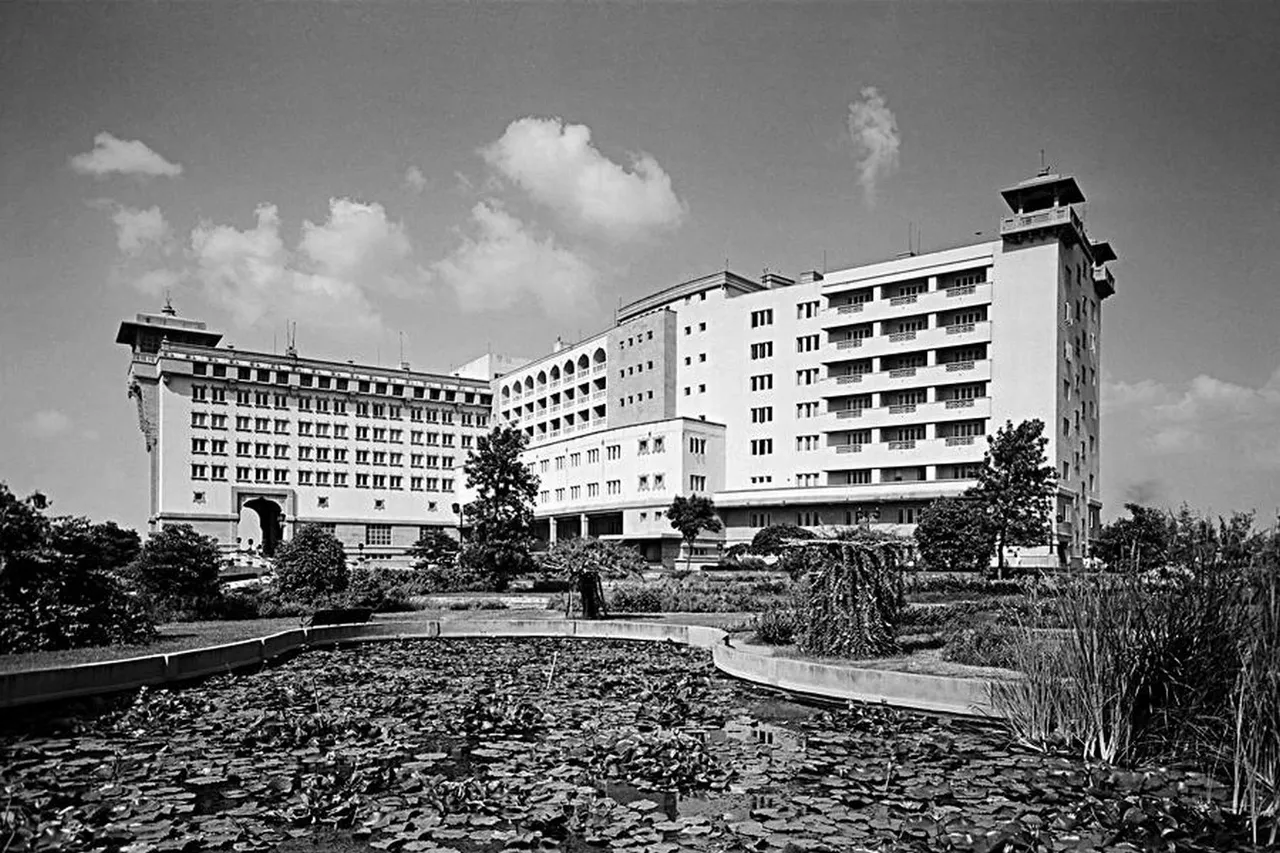
It’s a well-known fact that Ashok Hotel is managed by ITDC. But ,did you know, the Ashok Hotel in New Delhi was built in 1956, a full decade before the Indian Tourism Development Corporation (ITDC) was founded on October 1, 1966.
On this day, we take you back in history to the story of how one of Delhi’s oldest Tourist icons was built in 15 months to host an event of the United Nations.
Let’s rewind back to Paris in 1955, Prime Minister Nehru wanted the UNESCO meet to be hosted by India. The permission was granted. However, on his return, he was informed by his officials that Delhi did not possess the necessary infrastructure to host an international event. A hotel and a convention centre were basic essentials to host the 9th General Conference of UNESCO, a gathering of global delegates and thinkers.
Bharat could not afford embarrassment on an international stage, so the government commissioned The Ashok – a massive, elegant hotel designed to reflect Bharat’s modernity and tradition. The Ashok was not just bricks; it was a symbol of Bharat stepping into the global spotlight, determined to show the world it could match international standards.
Twenty- Five acres of land for the construction of the hotel was donated by Karan Singh, the Prince Regent of Jammu and Kashmir. Interestingly, rulers of the erstwhile princely states funded the hotel and they became the shareholders as well.
Twenty-five acres of land on a rocky forest hillock was donated to the government to build Ashoka Hotel by the prince regent of Jammu & Kashmir, Karan Singh. In fact, the primary funding for the construction also came from the erstwhile princes; 15 out of the twenty-three original shareholders of the hotel were the rulers of various princely states
15 months later, Ashok was built and hosted the UNESCO conference and also the World Buddhist Conference in 1956. The Ashok was not just bricks; it was a symbol of Bharat stepping into the global spotlight, determined to show the world it could match international standards.
And why talk about this today? Because on 1 October 1966, exactly a decade after The Ashok was completed, Bharat created a dedicated institution, the Indian Tourism Development Corporation (ITDC), to carry forward that same mission: showcasing Bharat to the world. The Ashok became ITDC’s flagship property, and to this day, it remains the jewel in its crown. This date marks a pivotal moment in Bharat’s tourism history.
This story is not just about tourism, but about how a UNESCO conference and a hotel in Delhi set the stage for Bharat’s international tourism journey. Below are the facts that show how this journey is unfolding.
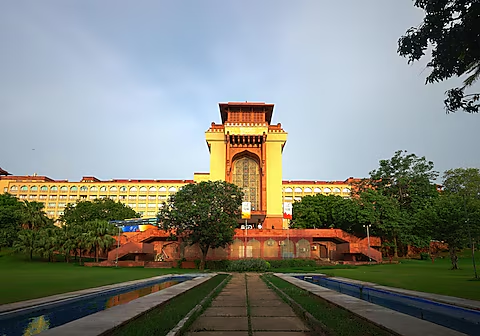
The Ashok Hotel in Chanakyapuri, a landmark that wasn’t just another hotel – it was a statement of intent. 1
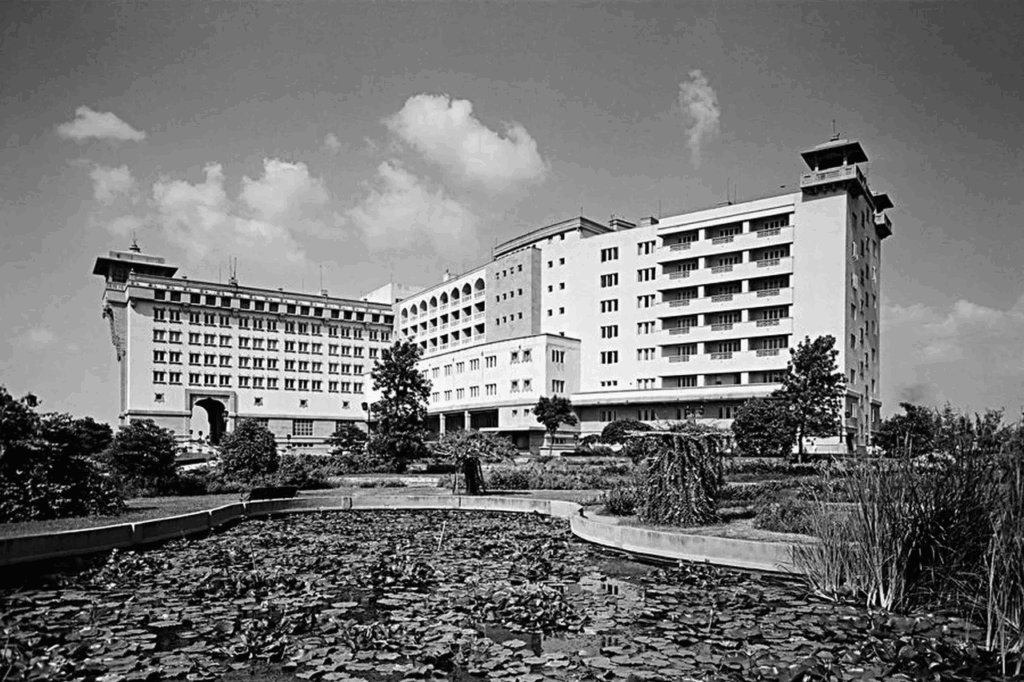
Ashoka Hotel, Madan Mahatta, 1957 (Image Source: Madan Mahatta Archives and PHOTOINK, New Delhi) Image link
From UNESCO’s Conference to ITDC’s Birth
Ashok’s story begins in 1956. With the UNESCO conference on the horizon, the Government of Bharat realised that if Bharat had to present itself as a serious host nation, it needed infrastructure worthy of global leaders and intellectuals. The Ashok was built in record time in Chanakyapuri, New Delhi’s diplomatic enclave—serving as a palace of hospitality. For many foreign visitors, this was their very first impression of Bharat after independence.
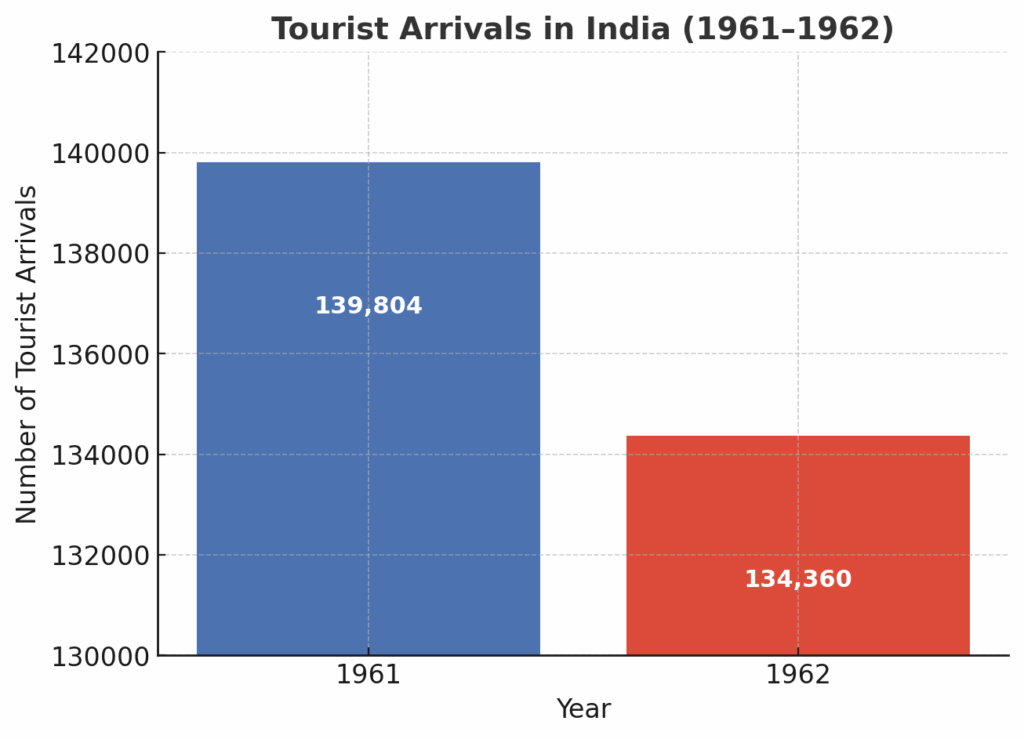
By the early 1960s, however, Bharat’s tourism sector was struggling. After steady growth in the 1950s, tourist arrivals dipped: numbers fell from 139,804 in 1961 to 134,360 in 1962, just before the Sino-Indian war dealt an additional blow. Despite its potential, tourism contributed only about 3% of Bharat’s exports in 1961, showing the sector’s untapped promise.
It was against this backdrop that the government decided to institutionalise its tourism vision. On 1 October 1966, the ITDC was incorporated under the Companies Act, 1956. Its job was clear: build and manage hotels, provide tourist transport, run duty-free shops, promote Bharat abroad, and most importantly, ensure no global event ever found Bharat underprepared again. The Ashok—originally built for UNESCO—naturally became the crown jewel of this new corporation.
Tourism in the Early Days: Backpackers, Seekers, and Hippies
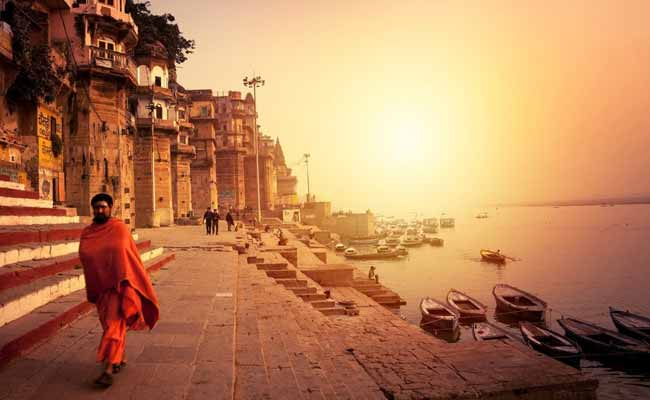
The 1960s also saw Bharat attract a unique category of international visitors. The overland route from Europe through Afghanistan and Pakistan to Bharat brought in thousands of backpackers, spiritual seekers, and the so-called hippie generation. They weren’t luxury travellers looking for five-star hotels; they were in search of Bharat’s philosophy, mysticism, and yoga.
But while these early waves helped Bharat earn a reputation for spirituality, they did little to boost foreign exchange. For that, the government needed an institutional body like ITDC that could cater to conventions, high-end travellers, and structured circuits. Thus, the symbolism of The Ashok Hotel meeting UNESCO’s needs extended into ITDC’s long-term mandate—Bharat had to be ready for every kind of visitor.
The Five-Year Plan Push and ITDC’s Expansion
Bharat’s planners were quick to integrate tourism into development policy. The First Five-Year Plan initiated overseas tourist offices, the Second Plan earmarked INR 1.08 crore for tourism infrastructure, and the Third Plan paved the way for ITDC’s creation. By the Fourth Plan, the emphasis shifted to foreign exchange earnings, while the Sixth Plan added social benefits, tourism education, and even the 1982 Tourism Policy.
The ITDC grew accordingly. Hotels like Samrat, Kalinga Ashok, Lalitha Mahal Palace, and Akbar Hotel followed The Ashok, giving the corporation a pan-Bharat presence. It wasn’t just building hotels—it was building confidence that Bharat could match global standards.
From Symbolism to Strategy: The Ashok’s Legacy
What makes The Ashok special is that it was born of a UNESCO moment but became a long-term Bharat’s institution. Few hotels in the world can claim such a dual role—built for one international conference, yet still central to the country’s tourism strategy seventy years later.
The Ashok also represents a bridge between Bharat’s early aspirations and modern realities. While the private sector now dominates luxury hospitality, The Ashok and ITDC continue to hold symbolic and functional importance. For instance, The Ashok remains the chosen venue for government conferences, global summits, and cultural festivals.
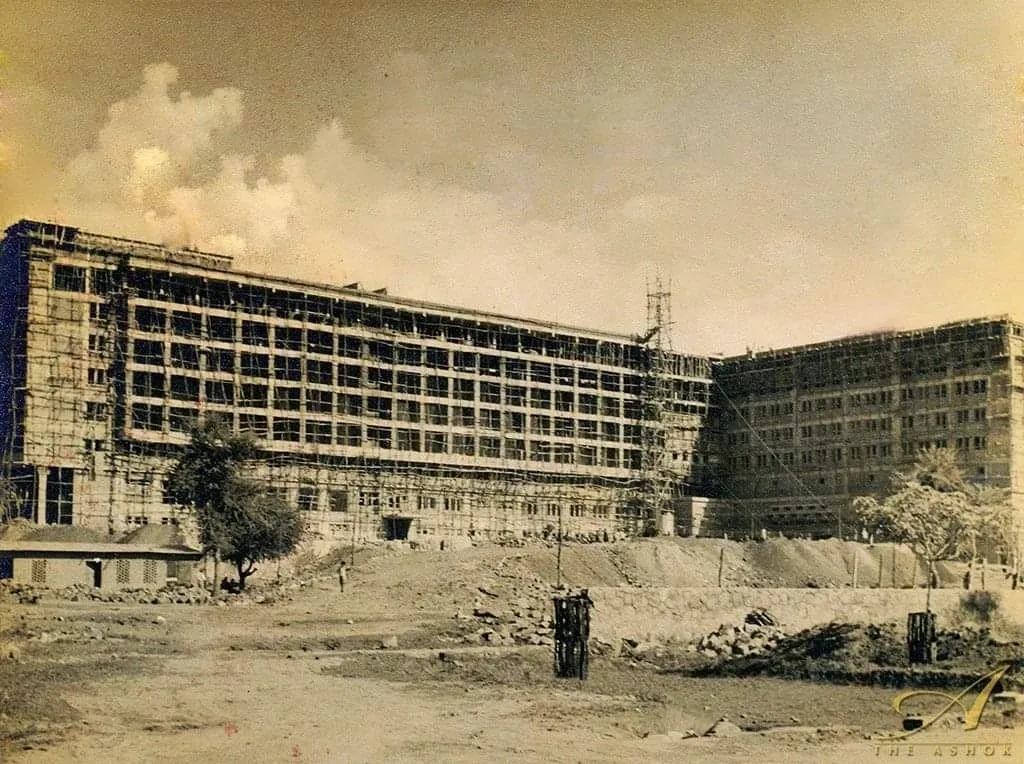
Hotel Ashoka was later christened The Ashok in 2007 at the time of its construction in 1956 (Image Source: The Ashok, Facebook) Image Link
Connecting the Past to Today’s Tourism Landscape
Fast forward to the present, Bharatiya tourism model has vastly expanded beyond hotels. The government has rolled out major initiatives like Swadesh Darshan 2.0 for destination-centric tourism, PRASHAD for pilgrimage upgrades, and corridor projects such as Kashi Vishwanath Dham and Mahakal Lok that are attracting record visitors. Connectivity projects in Lakshadweep, the e-Visa system extended to 166 countries, and the integrated model around the Statue of Unity all show how Bharat is scaling up.
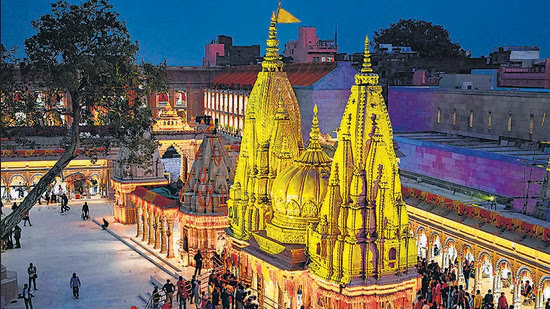
Kashi Vishwanath Dham (Image Source: PTI)
Mahakal Lok (Image Source: PTI) Image link
Lakshadeep (Image Link)
But it’s important to remember: none of these would have had a solid foundation if not for the early realisation—crystallised in 1956 with UNESCO’s conference—that Bharat needed infrastructure, branding, and organisation. The Ashok became the proof of concept; ITDC became the system to replicate and expand it.
ALSO READ: “Discover Lakshadweep’s Coral Beauty Like PM Modi: 5 Must-Try Activities for Your Bucket List!”
Why This Story Matters
So, why tell this story today? Because 1 October is not just ITDC’s establishment day—it is also the anniversary of a mindset shift in Bharat’s tourism history. From the UNESCO conference in 1956 to the establishment of ITDC in 1966, and now to a booming tourism sector crossing record arrivals, the arc is clear: Bharat went from being unprepared to being a prepared global host.
The Ashok Hotel stands as a monument to that journey. It was never just about hosting UNESCO delegates—it was about signalling to the world that Bharat was ready to welcome it. And that signal continues to echo through every corridor of Bharat tourism policy today.